


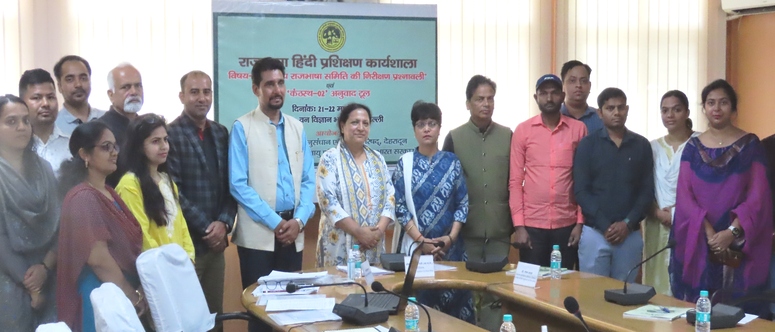
वन विज्ञान भवन, नई दिल्ली में 21-22 मार्च 2024 तक दो दिवसीय राजभाषा प्रशिक्षण कार्यशाला का आयोजन
 View Report
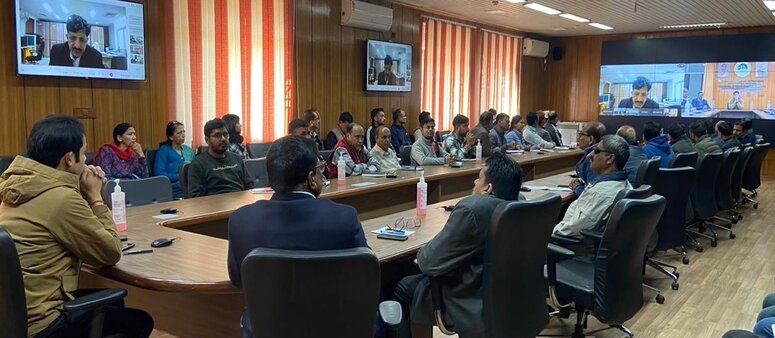
Online training on eOffice By Shri Anna Durai, Senior Consultatnt (IT), MoEF&CC for ICFRE officials on 28th February 2024
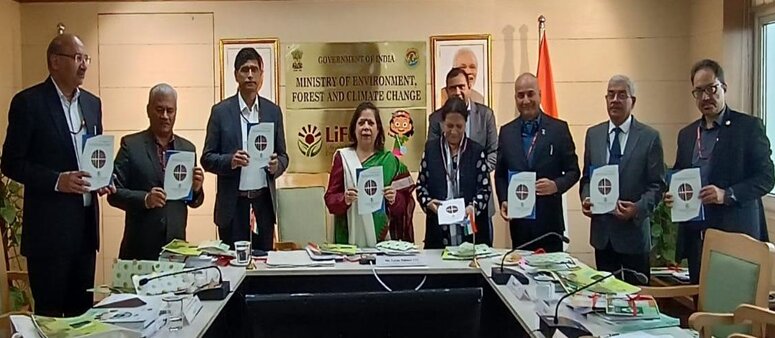
Publication released by Mrs. Leena Nandan, Secretary, MoEF&CC in the 61st Board of Governors meeting of ICFRE on Soil Health Card; Integrated Identification Method for Distinguishing b/w Dalbergia latifolia and Dalbergia sissoo; and Miyawaki Plantation
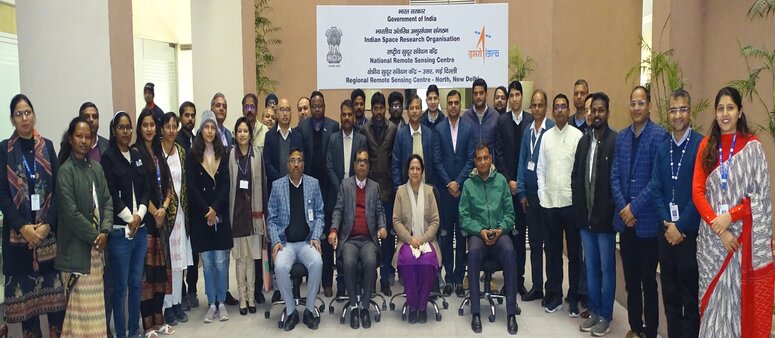
Two days workshop held on 29-30 January, 2024 on "Advanced Remote Sensing Techniques for forestry applications" for IFS Officers and Scientists of ICFRE
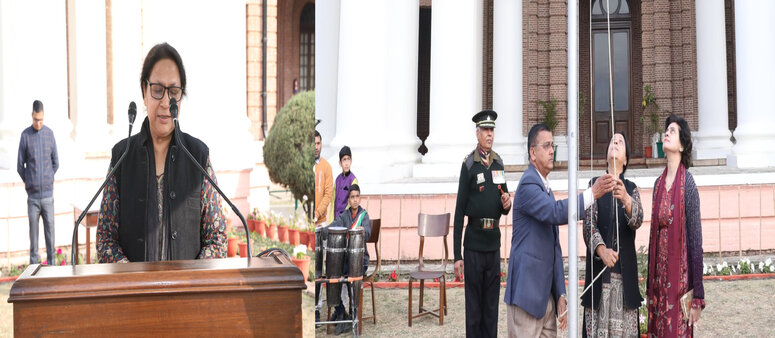
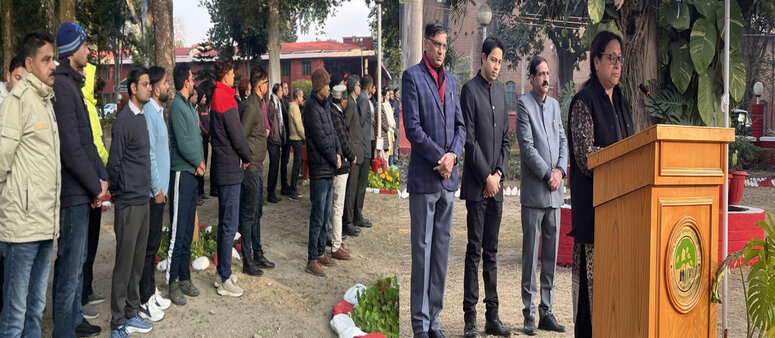
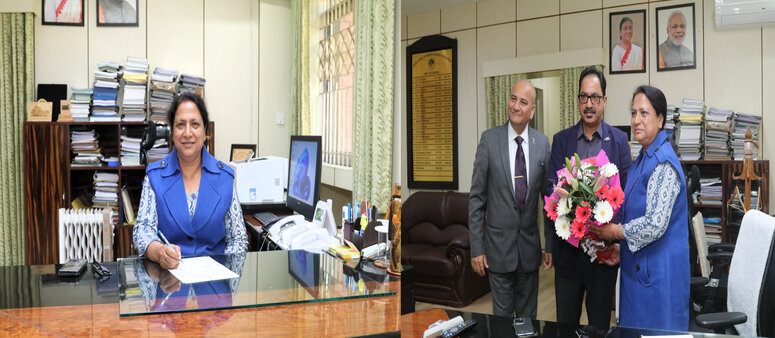
Mrs Kanchan Devi, IFS, 1991 batch has taken over the charge of Director General, ICFRE. She is the 1st lady IFS officer to hold this prestigious position.
 View Photo Gallery
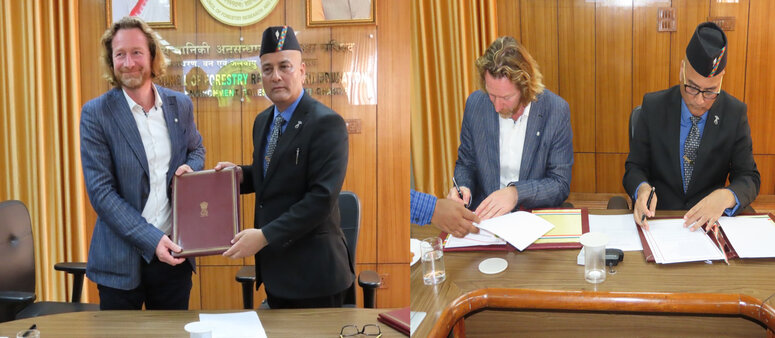
MoU between ICFRE, Dehradun & Alliance of Bioversity International and CIAT, Italy, signed by Dr Jagmohan Sharma, DG, ICFRE & Dr Christopher Kettle, Principal Scientist & Programme Leader on 22.11.2023
View Photo Gallery
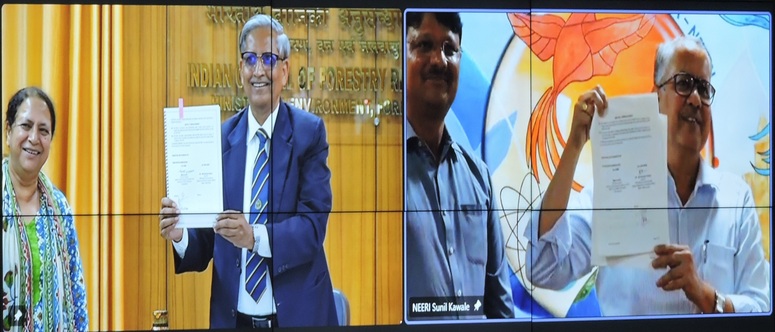
MoU signing ceremony between ICFRE and CSIR- NEERI on 30th October 2023
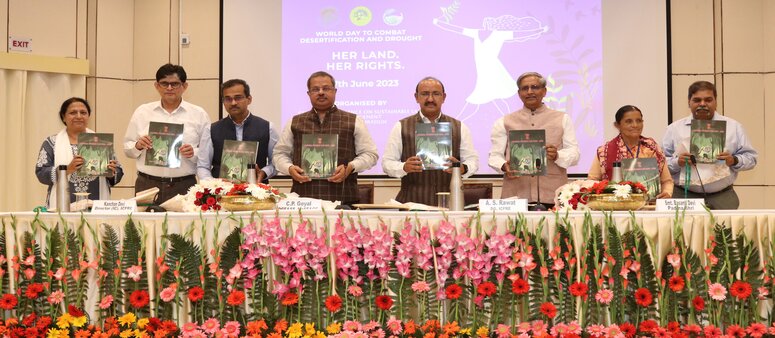
Centre of Excellence on Sustainable Land Management, ICFRE Dehradun celebrates World Day to Combat Desertification and Drought on 17th June 2023
View Photo Gallery

Director General's Message

Smt. Kanchan Devi
Director General ICFRE
Forthcoming Events
 Short Term Training Course Calendar-2024 of ICFRE-FRI, Dehradun updated: 01 April 2024
Bulletin Board 
Newsletter, Vol-I, Issue-I (October-December,2023) ICFRE-RFRI, Jorhat updated: 27 March 2024
Short Term Training Course Calendar-2024 of ICFRE-FRI, Dehradun updated: 06 March 2024
Price list for newly developed variety of Neem seeds, Seedlings by scientist/ researchers of Forest Research Institute, Dehradun updated: 16 February 2024
Order and Act, 2013 pertaining to " The Sexual Harassment of Women at Workplace" updated: 10 November 2023
Circular regarding launch of the ICFRE Pension Portal and Mobile application on 7th August 2023 by DG, ICFRE updated: 08 August 2023
Updates from ICFRE Institutes
Report on Celebration of Earth Day-2024 at ICFRE- Himalayan Forest Research Institute Shimla HFRI: 24 April 2024
A Report on Earth Day, Celebrated in ICFRE-Institute of Forest Productivity, Ranchi on March 22.04.2024 IFP: 24 April 2024
ICFRE-Rain Forest Research Institute, Jorhat (Assam) organized a week-long National level training on bamboo from 22nd to 27th January,2024. RFRI: 23 April 2024
ICFRE-Rain Forest Research Institute, Jorhat (Assam) organized Tree Growers' Mela, sponsored by CAMPA from 7th to 8th March,2024 RFRI: 23 April 2024
Earth Day 2024 Celebrations by ICFRE-IFGTB EIACP PC RP IFGTB: 23 April 2024
WORKSHOP REPORT ON ‘TreeGenie’ – A DIGITAL INTERACTIVE PLATFORM IFGTB: 23 April 2024
Report on 133rd Birth Anniversary Celebration of Dr. Babasaheb Ambedkar on 15.04.2024 at ICFRE-Institute of Forest Genetics and Tree Breeding, Coimbatore IFGTB: 16 April 2024
Training on quality planting material production in nursery-Madurai IFGTB: 05 April 2024
Training on quality planting material production in nursery- Tirunelveli IFGTB: 05 April 2024
Training Report on Red Sanders – Lord’s Own Tree (Under VVK, Coimbatore) IFGTB: 03 April 2024
ICFRE-Bamboo and Rattan Centre (ICFRE-BRC) Bethlehem VengthlangAizawl, organized a’ three days hands-on training cum exhibition under Van Vigyan Kendra, Mizoram BRC: 02 April 2024
Report on "Sustainable Land Management Practices for Rehabilitating Degraded Land" under VVK organized at ICFRE-IFB, Hyderabad on 07.03.2024 IFB: 02 April 2024
वन विज्ञान भवन, नई दिल्ली में 21-22 मार्च 2024 तक दो दीवसीय राजभाषा प्रशिक्षण कार्यशाला का आयोजन -: 02 April 2024
ICFRE Technologies
Tree PALH is a biopesticide product which has been developed as an alternative to chemical pesticides for the management of insect pests of forestry importance. Use of Hydnocarpic acid as biopesticide is first of its kind and combination with neem oil and essential oil of Lantana is a new approach.
Biopesticides
“Tree Rich Biobooster” is a comprehensive potting mixture provides requisite nutrients and protects plants from pest and diseases. It is made from coconut fiber waste duly decomposed and enriched with all nutrients through various beneficial microbes.
Tree Rich Biobooster- An alternate potting mixture for plant production.
ArborEasy® DNA isolation kit is a spin column based genomic DNA isolation kit. ArborEasy® is a registered trademark. The isolation Kit provides an indigenous, nonbio-hazardous, low cost pin column based system for isolation of plant genomic DNA from wide range of tissue types, specifically tree tissues.
ArborEasyTM DNA Isolation Kit
Institute of Forest Genetics and Tree Breeding (IFGTB), is working on genetic improvement of Eucalyptus, Casuarina, Acacias and fast growing native tree species. This targeted research is carried out in close collaboration with the Paper industries and farmers to meet the raw material demand and increase the farm income.
Commercialization of Clones of Casuarinas and Eucalyptus
Commiphora wightii (Arn.) Bhandari, commonly known as guggal, is a medicinally important desert species of the family burseraceae. It is a well known for its valuable active principle found in its oleo-gum-resin (guggulsterone E and Z), which are used in drugs preparation for lowering the cholesterol level in human body.
Conservation and Species Restoration of Critically Endangered Medicinal Plant
Fresh eggs of rice moth, Corcyra cephalonica (Stainton) (Lepidptera : Pyralidae) were pasted on paper cards and hanged in teak forests for 2-3 days during last week of June in Udaipur (compartment No. 298 RF), Kalpi Forest Range, Mandla Forest Division, MP.
TFRI Tricho cards
Teak (Tectona grandis) is one of the major forest timber tree species in central Indian states of Madhya Pradesh, Chhattisgarh, Maharashtra and Orissa. In central India, the preferred planting material is root-shoot rather than teak seedlings grown in root trainers.
Management of white grubs in teak nurseries
Bio-fertilizers or microbial inoculants are preparations containing live or latent cells of efficient strains of nitrogen fixing, mineral solubilizing, or cellulolytic microbes used for application to seed, soil or composting areas to augment the extent of availability of nutrients to plants. Biofertilizer has been extensively applied and accepted worldwide in agricultural crops, however, its application in forest tree species remains restricted.
Production and distribution of biofertilizers of microbial origin
Juniperus polycarpos C. Koch is an important indigenous conifer of North-Western Himalayan Region, commonly known as “Himalayan Pencil Cedar”. The seeds of this species have dormancy which affects its germination. Technology for breaking seed dormancy has been developed at HFRI during last 5 years.
Seed Technology of Juniperus polycarpos (Himalayan Pencil Cedar)
Picrorhiza kurrooa, Royle ex Benth. commonly known as Kutki is an important temperate medicinal plant found in western Himalayas, which has a great potential for commercial cultivation in higher temperate regions (above 2700 mts.).
Macro-proliferation technique for Kutki Multiplication
Valeriana jatamansi, Jones commonly known as Mushakbala is an important temperate medicinal plant species found in western Himalayas and possesses great potential for commercial cultivation. The species can be easily grown by seeds but the vegetative propagation has scientific advantage over sexual propagation
Macro-proliferation technique for Mushakbala Multiplication
Deodar (Cedrus deodara), one of the most valuable and dominant conifer species of the North-western Himalaya at certain intervals gets affected by a defoliator, Ectropis deodarae Prout, (Lepidoptera: Geometridae). This key pest seriously affects the younger crops in deodar forests.
Integrated Pest Management of Deodar Defoliator (Ectropis deodarae Prout)
The interspaces in the orchards of high hill temperate region can be better utilized and economic benefit from the orchards can be enhanced by intercropping selected commercially important medicinal plants.
Intercropping of temperate medicinal plants with horticultural plantation